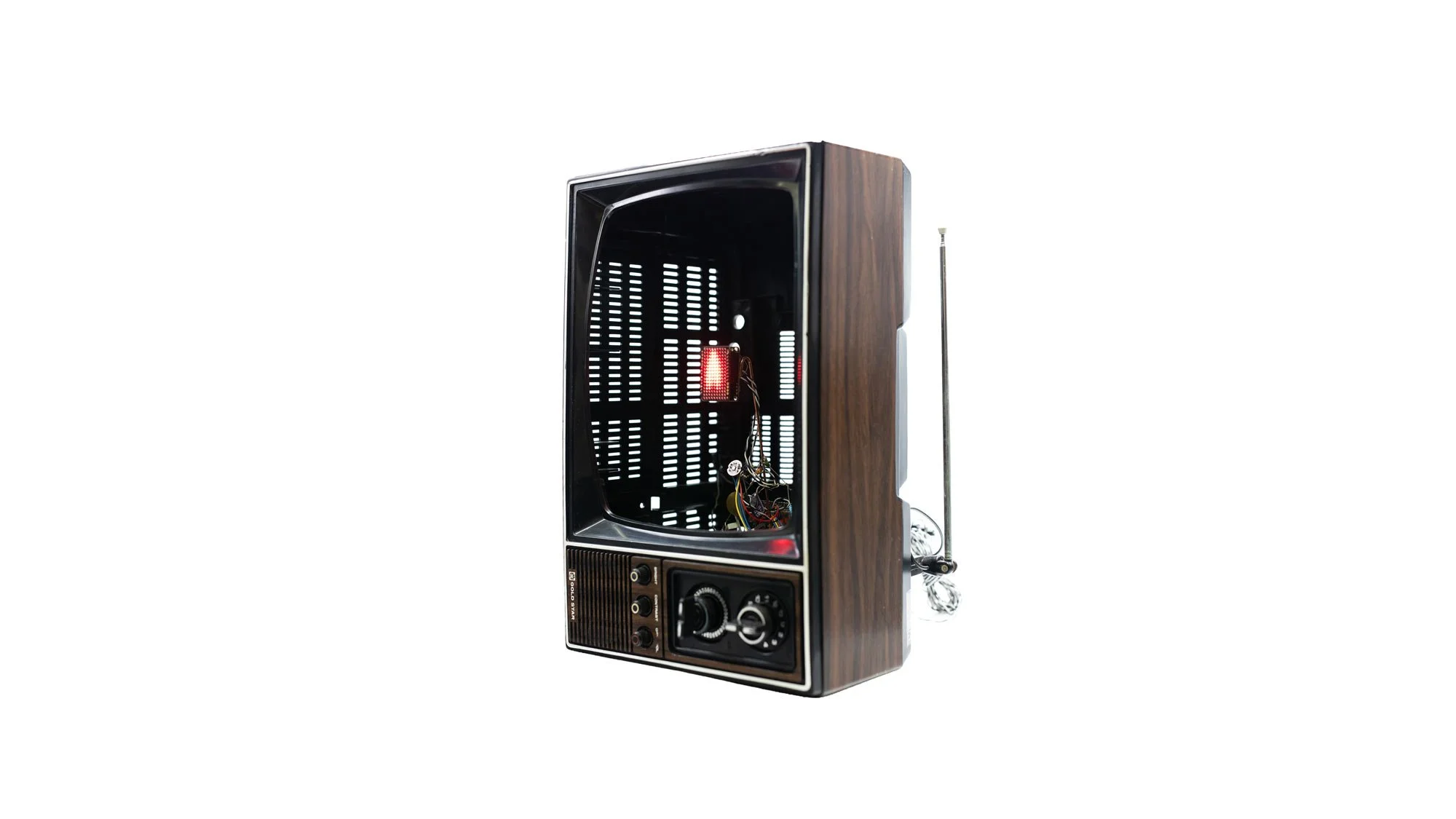
2018-04-22 (Candle TV in Digital Era)
CRT TV (SONY / GOLDSTAR / SAMSUNG), Arduino, LED matrix, USB Cable, USB Charger, E-waste Part
12.5(W) x 21(H) x 14(D) inch (31 x 51 x 35 cm)
Candle TV in the Digital Era
After the digital switchover, countless analog televisions were abandoned—once-central devices rendered obsolete by rapid technological evolution. Rather than seeing these machines as remnants of the past, I approach them as symbolic interfaces that carry technological memory and unresolved potential within the history of video art.
This work extends the lineage of video art initiated by Nam June Paik, particularly Candle TV, while responding to contemporary conditions shaped by code, networks, and intelligent systems. My decade-long experience as a technician in New York, repairing and preserving Paik’s works, informs this practice, grounding it in both material knowledge and historical continuity.
Candle TV in the Digital Era reimagines the flickering candle as a data-driven phenomenon. Breath becomes data. A candle becomes code. Analog signals are translated into digital information, visualized as a constantly shifting, flame-like state. Fire—humanity’s first discovered technology—functions as a metaphor for transformation, continuity, and rebirth within technological evolution.
The CRT television operates as an iconic yet restrained presence: a symbol of obsolete technology left behind by progress, and a vessel that holds accumulated cultural memory. Its physical weight and limitations contrast with the immaterial flow of digital information, exposing the tension between technological advancement and abandonment.
At the center of the work is interaction. Sound, breath, and environmental input activate the system in real time, giving rise to what I call a Digital Being—a primitive yet emergent form of consciousness born from discarded technology. Artificial intelligence plays a subtle but essential role by generating and refining the code that connects these interactions, enabling physical gestures and abstract data to continuously influence the system’s behavior.
The structure of the work reflects Gilles Deleuze’s concept of the Rhizome: non-hierarchical, layered, and constantly shifting. Text, image, sound, and light coexist without a fixed center, forming a living network rather than a linear narrative.
Ultimately, this work honors obsolete machines while questioning the direction of technological progress. It proposes a model for sustaining media art in the digital age—not through replacement, but through transformation—imagining a future where abandoned technologies give rise to new forms of digital life.
2018-08-06 (Candle TV in Digital Era)
CRT TV Monitor, Arduino, LED Matrix, Distance Sensor, USB Cable, USB Charger, TV Mount, Wood Panel, Screw, E-waste Part
7(W) x 13(H) x 10(D) inch (18 x 33 x 25.5 cm)
2019-01-19 (Candle TV in Digital Era)
CRT TV Monitor, Arduino, LED Matrix, Distance Sensor, USB Cable, USB Charger, TV Mount, Wood Panel, Screw, E-waste Part
7(W) x 13(H) x 10(D) inch (18 x 33 x 25.5 cm)
2022-01-19 (Candle TV in the Digital Era)
Gold Star CRT TV VR-230, Red LED matrix, driver module, antenna, ESP32, ESP8266, OLED display, mic module, wire, USB charger, price tag, e-waste parts — Programmed with Arduino IDE
10.5 x 12.5 x 11.5 inches (26.67 × 31.75 × 29.21 cm)
Wishing in the digital era
A breath becomes data.
A candle becomes code.
A Digital Being drifts through invisible wind—
between the real and the digital.
Being Digital
Made in WTC
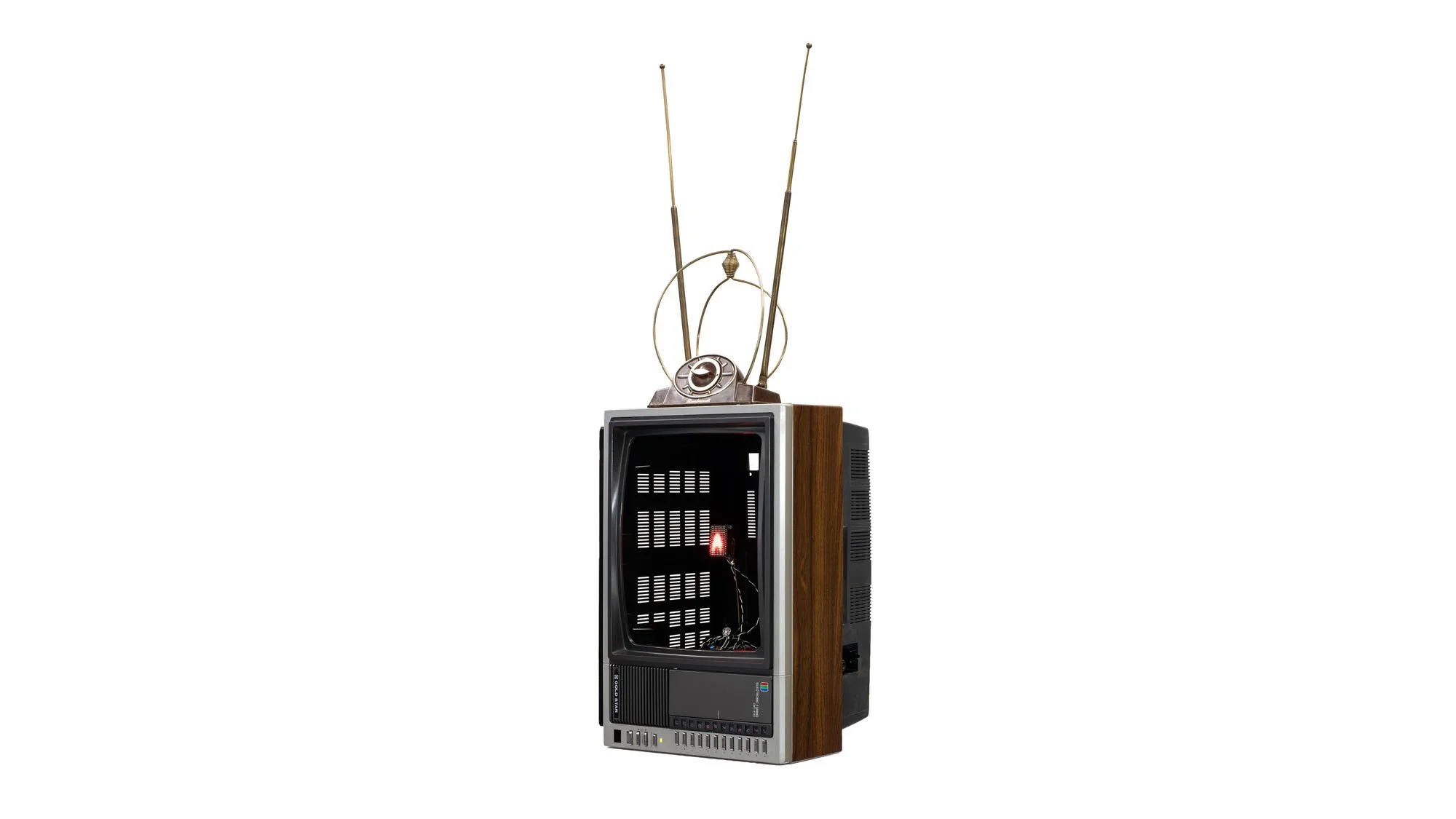
2023-08-06 (Candle TV in the Digital Era)
Antenna, CRT TV, Red LED matrix, ESP32, ESP8266, mmWave Sensor, OLED display, sound sensor, e-waste, wire, USB charger — Programmed with Arduino IDE + API
12.6 × 39.37 × 13.39 inches (32 x 100 x 34 cm) | 4.31kg (9.50 lbs)
I propose Candle TV in the Digital Era as a first attempt at an electronic media artwork that moves beyond a Thesus’s ship-like condition, in which electronic media artworks gradually become reduced to concept alone over time due to hardware obsolescence and software disappearance. Instead, it is conceived as a work that assumes, at least speculatively, the possibility of sustaining its original configuration for 100 years, 200 years, and even beyond 1,000 years.
Within this framework, the candle functions as a symbolic origin of human technology—the earliest form of controlled energy, illumination, and memory. The central concern of this work is to preserve and extend this fragile “digital flame,” understanding continuity not as static preservation, but as an ongoing act of maintenance, translation, and reconfiguration across time.
Through the design and implementation of an open-source–based hardware and software system, the work becomes a philosophical and technical inquiry into how electronic media can persist: how far such systems can extend, and in what forms they may continue to exist while still retaining their “original” through continuous reconstruction.
In the work 2023-08-06 (Candle TV in the Digital Era), there are three layers of interaction.
First, interaction within the digital realm (machine ↔ machine).
The candle’s movement is connected to real-time wind data from New York. Through a weather API, its flicker subtly accelerates or slows depending on the actual wind conditions in the city. In this sense, the work behaves somewhat like a digital wind chime, where the digital candle and digitized environmental data respond to one another within a shared digital domain.Second, interaction between reality and the digital realm (human ↔ machine).
Visitors can blow toward the candle to extinguish it. Their breath is detected by sensors and translated into a digital response. In that moment, the act of blowing becomes a brief interface where the physical world touches the digital system. Almost like making a wish, the visitor’s breath connects this idealized digital state with reality, producing a fleeting new data state.Third, interaction through presence (being ↔ system).
A mmWave-based digital being exists within the same environment, sensing human presence through distance. As visitors approach, it responds through gradual shifts in light and sound across multiple states. Rather than acting as a simple trigger, it behaves as an independent entity—quietly reacting to proximity, and introducing another layer of sensitivity into the system.
Inside the old television, these digital beings quietly trace encounters between physical gestures, environmental forces, and invisible signals—forming a small ecology that exists between the real and the digital.